
Nausheen Khan*
Introduction
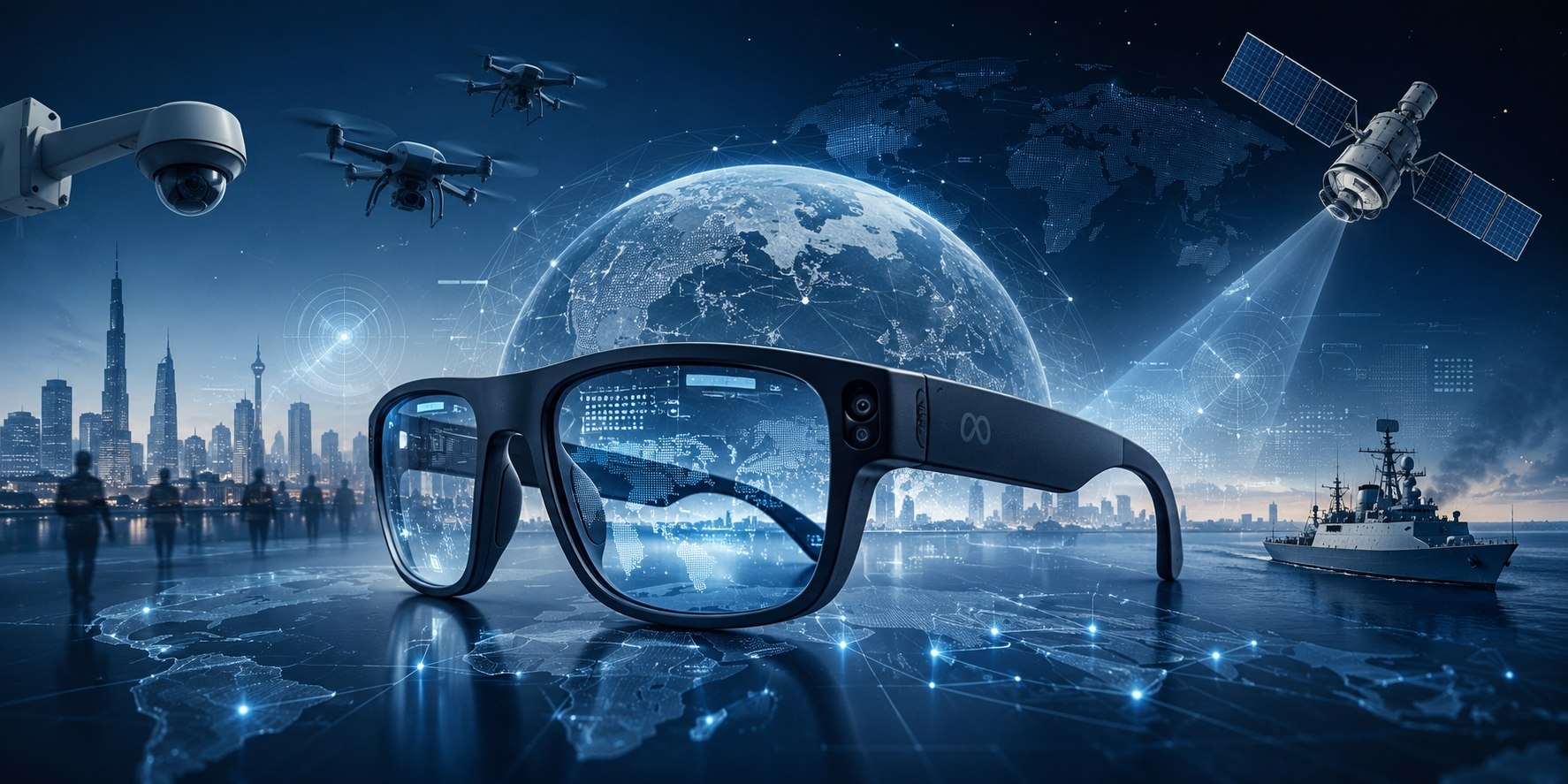
When Kylie Jenner’s promotion of Meta’s smart glasses drew massive backlash, questions arose about the nature of wearable AI technology, its potential security implications, and its unobtrusive nature, which could turn it into a means of surveillance and identity theft. For much of the twentieth century, surveillance has been imagined as the vertical exercise of power by governments and intelligence agencies, through the installation of CCTV cameras and similar technologies that manipulate human cognition and monitor citizens as a tool to reduce flak. Yet, the widespread dissemination of technology poses the risk of infringing on digital sovereignty by distributing power across surveillance nodes, with its concentration not just in the hands of big firms and corporations with a monopoly over its means, but also in a democratic diffusion among citizens at a reasonable price, fundamentally altering this architecture.
Sousveillance and the rematerialization of the human body
George Orwell’s 1984 stands as the most realistic parallel of contemporary surveillance. Orwell’s vision was rooted in state monopoly over information. The Party exercised surveillance as an instrument of coercion, relying on physical infrastructure and centralised authority. However, what differentiates the contemporary ecosystem from Orwell’s “sousveillance” by Steve Mann is the participatory consent embedded in Meta’s wearable smart glasses, enabling users to potentially record public interactions, social encounters, and civic spaces. Individuals simultaneously assume the roles of observer and observed, producer and subject of data. Individuals purchase devices that collect data, agree to expansive terms of service, and contribute continuously to digital ecosystems in exchange for convenience, connectivity, and personalised experiences.
An often-overlooked aspect of the technology is how it dematerialises the human body, reducing social interactions to digitally mediated communication. It violates the corporeal integrity of the human body, dismantling mobile borders of consent, underlining what is increasingly being termed the “epidermalisation of the human body”.
Similarly, Meta’s Ray-Ban AI glasses raise difficult questions regarding digital sovereignty. Meta’s smart glasses generate information that may traverse multiple jurisdictions before being processed by globally distributed cloud infrastructure. Questions therefore arise regarding data localisation, lawful government access, cross-border data transfers, and regulatory accountability. The European Union prioritises precautionary regulation through the AI Act and GDPR. The United States relies upon innovation-driven governance. China integrates technological development with state-directed digital governance, a form of extreme surveillance, while India thrives under the Digital Personal Data Protection Act, 2023.
National Security Implications-Meta as a geopolitical actor
AI technology also introduces new strategic considerations for national security. These identical technologies may facilitate espionage, industrial surveillance, disinformation, or the unauthorised collection of sensitive information, drastically violating principles of informed consent.
It poses risks of national security violations where civilian usage coexists with potential security risks. The camera in Meta’s glasses can be so unobtrusive that even their wearers have been caught off guard by what, when, and where they’re recording, and where those recordings are going. After workers in Kenya, tasked with watching videos made through Meta’s glasses to create AI training data for the company, said they were being required to watch graphic content like sex and bathroom usage, people who own the glasses filed two lawsuits. In one, people said they had no idea such videos had been made. In the other, they said they did not know their videos were being shared by the company for review.
It also illustrates a broader transformation where technology corporations are no longer merely commercial entities but increasingly function as geopolitical actors. With over three billion users across Facebook, Instagram, WhatsApp, and Messenger, the company is shaping the global flow of information and discreetly monitoring AI usage. Coupled with platform co-dependency, it poses serious risks regarding data storage, algorithmic moderation, AI deployment, and software interoperability of users across sovereign jurisdictions. It also shapes international relations, where countries such as the US benefit from the global dominance of firms like Meta, Google, Microsoft, Apple, and OpenAI, whose innovations reinforce American leadership in digital technologies. Consequently, AI wearables become instruments of geopolitical competition and may raise new forms of surveillance, something that has intensified especially after the 9/11 attacks.
Possible Pathways of Policy Implementations for Democratic Governance
Existing privacy legislation, designed primarily for smartphones and online platforms, is insufficient for technologies capable of continuously observing and interpreting physical environments. A structural loophole arises from the existence of a technology but a lack of effective regulatory oversight. First, governments should mandate transparency for algorithmic systems in wearable AI. A co-producing ecosystem needs to be developed in which users are aware of the visual processing, data storage, and usage built into algorithmic operations. Second, international standards should regulate biometric surveillance and facial recognition within consumer wearables. Stricter safeguards and need-based proportionality are the need of the hour to accurately assess the impact of the technology. Thirdly, cross-border cooperation on AI governance must be expedited, especially among G20 nations, through global forums and multilateral initiatives. Independent auditing mechanisms for high-risk AI systems with in-built external evaluation are vital. Finally, digital literacy should become a central component of democratic resilience for preserving digital autonomy in an increasingly AI-driven society.
Conclusion
Since surveillance is the prevailing reality of today’s times, it is important to understand that Meta’s AI smart glasses are at the centre of a broader technological ecosystem in which artificial intelligence, behavioural data, cloud computing, and platform power converge. Their implications extend into national security, international political economy, digital sovereignty, and democratic governance. The central challenge lies in developing measurable policy outcomes to address the same.
The author holds a B.A.(Hons.) in Journalism from Lady Shri Ram College for Women, University of Delhi; and currently pursuing M.A. in Politics (International Relations) from Jawaharlal Nehru University.
No responses yet